
📌 Key Takeaways
- Choose a region before choosing attractions. Focusing on Lucerne, the Bernese Oberland, Zurich and the Rhine Falls, or Bern helps keep travel manageable.
- One day can offer several complementary experiences. A city walk, scenic viewpoint, lakeside stop, or local food experience can work well together when planned around a realistic route.
- Your starting location matters. A destination that is practical from Lucerne may be less suitable for a day trip from Zurich or Geneva.
- Seasonal conditions influence mountain excursions. Weather, visibility, operating schedules, and access to mountain transport can affect the day’s plans.
- Prioritise quality over quantity. A few meaningful stops generally create a more enjoyable experience than trying to cover several distant regions.
Switzerland offers an extraordinary variety of experiences within a relatively small country, from Alpine mountain views and turquoise lakes to historic towns, traditional villages, and famous Swiss chocolate and cheese. With a well-planned itinerary, day tours in Switzerland can combine beautiful scenery, cultural discoveries, and memorable local experiences without requiring an overnight stay at every destination.
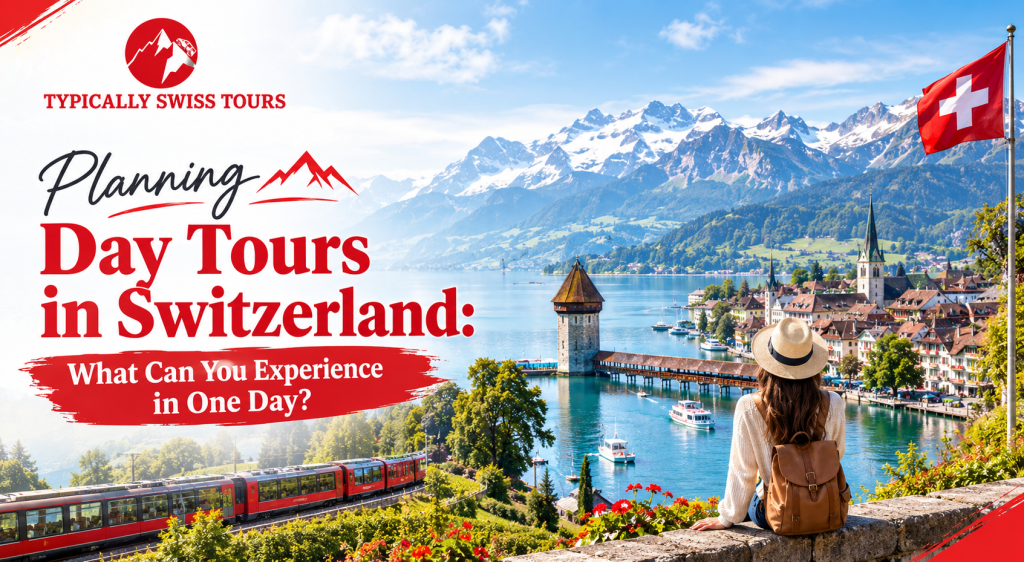
The key is to choose one region, identify the experiences that matter most, and allow enough time to enjoy each stop rather than spending the entire day travelling. A day around Lake Lucerne might include lakeside villages, historic sights, and a mountain excursion, while a tour through the Bernese Oberland could focus on Alpine landscapes, waterfalls, and charming mountain communities.
For travellers visiting from the United States, a carefully planned one-day tour is particularly useful when Switzerland is one stop on a longer European holiday or when several highlights need to fit into a limited itinerary. The right route depends on your starting point, the season, your interests, and how much time you want to spend exploring rather than travelling.
What Can You Experience on a Day Tour in Switzerland?
A well-organised day tour can bring together natural scenery, local culture, historic landmarks, and regional food. The best combination depends on the region you visit and the time required to reach each attraction.
1. Explore Lucerne and the Surrounding Lakeside Villages
Lucerne, also known as Luzern, is an appealing starting point for travellers who want to experience historic architecture, lakeside scenery, and nearby mountains in one day.
A day exploring this region could include:
- Walking across Chapel Bridge and through Lucerne’s historic Old Town.
- Admiring views across Lake Lucerne and its surrounding mountains.
- Visiting a lakeside village such as Weggis or Brunnen.
- Taking a mountain excursion to Mount Pilatus, Mount Rigi, or another suitable nearby destination.
- Discovering a local craft producer or chocolate-making experience.
The main planning decision is whether to prioritise the city, the lake, or the mountains. Combining all three can be rewarding, but the route needs to account for transport connections, activity schedules, and time spent at each stop.
Travellers particularly interested in the city’s architecture and riverside streets can also read Luzern Guided Tours: Best Way to Explore Lucerne Old Town.
2. Enjoy Mountain Views and Alpine Landscapes
A mountain-focused day tour is ideal for visitors who want dramatic landscapes, fresh mountain air, and panoramic viewpoints. Depending on the region and conditions, a trip may involve a mountain railway, cable car, scenic drive, short walk, or a combination of these activities.
Mount Pilatus, Mount Rigi, Mount Titlis, and the Jungfrau region offer different ways to experience the Swiss Alps. However, they are not interchangeable stops on a single easy itinerary. Each has its own access routes, transport arrangements, and time requirements.
For example, travellers staying near Lucerne might plan their day around one mountain excursion and time in the city. Those based in the Bernese Oberland might focus on Alpine villages, waterfalls, and mountain scenery closer to their accommodation.
Before booking, check whether mountain transport operates on your intended travel date and whether maintenance closures or weather could affect access. Reaching a summit does not guarantee clear views, so it is sensible to have an alternative activity at a lower elevation.
3. Discover the Bernese Oberland’s Villages, Waterfalls, and Valleys
The Bernese Oberland is a strong choice for travellers drawn to mountain villages, green valleys, waterfalls, and traditional Alpine scenery.
Rather than treating the region as a checklist, plan a route around a particular valley or cluster of nearby destinations. This creates time to appreciate the landscapes, stop for photographs, enjoy a meal, and explore a village without continually watching the clock.
Depending on your starting point and chosen route, possible experiences include:
- Visiting scenic villages surrounded by mountain peaks.
- Stopping at waterfalls and other natural viewpoints.
- Enjoying a short, manageable walk through an Alpine setting.
- Exploring local shops, cafés, or traditional village streets.
- Travelling along scenic roads through the countryside.
The key consideration is distance. Beautiful destinations that look close together on a map may require substantial travel time because of mountain roads, railway connections, or transfers.
A day tour works best when the itinerary focuses on the experiences that interest you most rather than attempting to cover the entire Jungfrau region.
4. Combine Zurich’s Urban Attractions with the Rhine Falls
Travellers staying in Zurich can consider an itinerary that combines city sightseeing with the Rhine Falls and, where time allows, Stein am Rhein.
Zurich offers a mix of historic streets, riverside walks, cultural attractions, and contemporary city life. The Rhine Falls provides a contrasting natural experience, while Stein am Rhein is known for its historic town centre and decorated building façades.
A practical itinerary might include a morning exploring selected parts of Zurich, followed by a visit to the waterfall. Stein am Rhein can be added if the travel time, opening hours, and planned activities make it realistic.
This route is especially attractive for visitors who want to experience more than a city centre during a limited stay. However, the number of stops should reflect the day’s available hours rather than an ambition to see every highlight.
5. Experience Swiss History and Regional Traditions in Bern
Bern offers a different perspective on Switzerland, with historic architecture, covered shopping arcades, riverside scenery, and landmarks such as the Zytglogge clock tower.
A city-focused day can leave enough time to appreciate the historic centre, explore local shops, stop for lunch, and learn about the region’s cultural heritage.
Travellers who want to venture beyond the city may consider combining Bern with selected parts of the Emmental countryside. The appeal lies in the contrast between urban history and rural landscapes, not simply in collecting more destinations.
For a route involving both locations, consider the time required to move between stops and how much walking you wish to do. Museum visits, guided experiences, and food tastings can all affect the amount of sightseeing possible.
6. Include Swiss Chocolate, Cheese, and Local Food Experiences
Food-focused day tours allow visitors to explore Swiss traditions through local products, production methods, and tastings.
Chocolate and cheese experiences can complement a sightseeing itinerary or form the main purpose of the day. Depending on the chosen location, visitors might explore a chocolate producer, learn about traditional cheese-making, or sample regional specialities.
This option works particularly well for families, couples, and travellers who prefer cultural activities over strenuous hikes or mountain excursions.
Plan around the actual visit rather than assuming every producer offers the same experience. Factory tours, tastings, admission arrangements, and opening hours can vary. Confirm what is available before finalising the route.
How to Choose the Right Day Tour in Switzerland
The best day tour is not necessarily the one with the longest list of attractions. It is the one that fits your base, interests, travel time, and preferred pace.
Consider these five factors before selecting an itinerary.
Start With Your Accommodation
Identify where you will sleep the night before and after the tour. A day trip from Lucerne should usually focus on accessible destinations in Central Switzerland, while a day starting in Zurich may suit northern or eastern Switzerland better.
If you are travelling between cities during the same day, account for luggage, check-in arrangements, and onward transport. Avoid creating an itinerary that depends on several tight connections when a more direct route is available.
Decide on One Main Experience
Choose the activity you most want to remember. It might be reaching a mountain viewpoint, exploring a historic town, enjoying an Alpine valley, or visiting a chocolate producer.
Build the rest of the day around that priority. Other stops should complement the main experience rather than compete with it for time.
Allow Time for Unexpected Delays
A realistic itinerary includes time for meals, short walks, photographs, and transitions between activities. Mountain transport, boat departures, road conditions, and seasonal schedules can influence the day’s timing.
Leave some flexibility around your most important activity, particularly when the experience depends on clear weather.
Match the Route to Your Travel Style
Travellers who enjoy independent exploration may prefer a route organised around train and boat connections. Visitors who value flexible stops, local context, or a more personalised schedule may prefer a private guided excursion.
Families may need shorter walking distances and breaks. Photography enthusiasts might want fewer stops with more time at each viewpoint. Travellers interested in food may prefer to reserve time for tastings rather than fitting them between multiple landmarks.
Check What the Tour Price Includes
Before confirming a booking, find out what the price covers. Depending on the arrangement, costs may include guiding and transport, while mountain railways, cable cars, boat cruises, entrance tickets, meals, and tastings may be charged separately.
Also confirm the departure point, expected duration, group size, cancellation terms, and arrangements if weather affects the itinerary. Comparing tours on these practical details gives you a clearer picture of the overall cost and experience.
How Private Guided Tours Can Make a Day More Flexible
A private guided tour can be helpful when you have limited time, specific interests, or several people with different preferences.
Instead of following a fixed group itinerary, a private tour may offer more opportunity to discuss the route, prioritise certain attractions, and adapt the pace. This can be particularly useful for combining sightseeing with short walks, scenic stops, and regional experiences.
Local knowledge can also help you understand the character of a destination beyond its most recognisable landmarks. A guide may provide historical context, explain local traditions, or suggest alternatives when a planned activity is unsuitable.
For travellers considering this approach, Typically Swiss Tours: private guided tours of Switzerland provides a starting point for exploring the business and its guided experiences.
Typically Swiss Tours offers a range of one-day routes, including experiences around Lake Lucerne, mountain excursions, the Bernese Oberland, Zurich and the Rhine Falls, Bern and Emmental, and Swiss food producers. The most suitable option will depend on your starting location, preferred activities, and travel dates.
You can review the available one-day tours in Switzerland to compare the destinations and discuss which route best matches your plans.
A private tour is not automatically the best option for every traveller. Independent public transport may suit visitors who enjoy planning connections and want to control costs. The right choice depends on how you prefer to travel and what you expect from the day.
When Is the Best Time to Plan Day Tours in Switzerland?
Switzerland offers different experiences throughout the year, and the best season depends on the type of tour you want.
Spring: Lower-altitude towns, lakefront walks, and historic city visits can make attractive choices. Higher mountain areas may still have snow or seasonal access limitations, so confirm conditions before booking.
Summer: Longer daylight hours can provide more time for sightseeing, lake activities, and walks. Popular destinations can also be busy, making an early start and advance planning useful.
Autumn: Changing foliage, cooler temperatures, and scenic countryside can make this a rewarding period for landscape-focused tours. Check the availability of mountain transport and seasonal attractions.
Winter: Historic cities, lakeside experiences, and selected mountain destinations remain possible, but daylight is shorter and snow or weather can affect access. Choose an itinerary with realistic travel times and alternatives.
There is no single best month for every excursion. A summer hiking route and a winter mountain visit may require very different preparations. Check operating schedules and local conditions close to your travel date, particularly when an itinerary depends on a cable car, mountain railway, or outdoor activity.
How Much Can You Realistically See in One Day?
Most travellers benefit from planning around a handful of connected experiences instead of attempting to visit several distant regions.
For example, a Lucerne itinerary might focus on the historic centre, a lakeside stop, and one mountain excursion. A Zurich itinerary could combine city sightseeing with the Rhine Falls. A Bern itinerary could centre on the Old Town and selected nearby rural attractions.
These are planning examples rather than fixed schedules. Actual feasibility depends on departure time, transport connections, attraction opening hours, weather, and how long you want to spend at each location.
A useful rule is to distinguish between the places you want to visit and the experiences you want to have. A brief photograph at a viewpoint and a leisurely walk through a village are very different uses of time, even if both count as one stop.
If a particular mountain, village, or attraction is the highlight of your trip, give it enough time to enjoy it properly. Adding another destination is rarely worthwhile if it turns the most anticipated part of the day into a rushed visit.
Sample One-Day Itineraries to Inspire Your Planning
The following outlines show how to organise a day around a central interest. They are illustrative routes, not confirmed tour schedules, and should be adjusted to departure points, seasonal conditions, and operating hours.
Option 1: Lucerne, the Lake, and Mountain Scenery
Best for: First-time visitors, couples, and travellers who want a balance of culture and scenery.
Begin with a walk through Lucerne’s historic centre, including Chapel Bridge and the surrounding Old Town. Continue to a selected lakeside location, then dedicate the main part of the afternoon to one accessible mountain excursion if conditions and schedules permit.
This itinerary combines architecture, water views, and Alpine scenery without trying to cover several separate regions.
Option 2: Zurich and the Rhine Falls
Best for: Visitors based in Zurich who want a mix of city life and nature.
Spend the first part of the day exploring selected city landmarks and historic streets. Travel to the Rhine Falls for the main outdoor experience. Add Stein am Rhein only if the available time and transport arrangements allow a comfortable visit.
This approach offers variety while keeping the journey centred on northern Switzerland.
Option 3: Bern and the Emmental Countryside
Best for: Culture enthusiasts, food lovers, and visitors interested in rural Switzerland.
Explore Bern‘s historic centre in the morning, allowing time to appreciate its architecture and local atmosphere. Continue into the Emmental region for a countryside experience or a suitable local food activity, depending on availability.
This route provides a contrast between a historic Swiss city and traditional rural landscapes.
Option 4: Chocolate and Cheese Experiences
Best for: Families, food-focused travellers, and visitors who prefer cultural activities over extensive walking.
Choose one or two suitable producers or food-related attractions within a manageable area. Allow sufficient time for any guided visit or tasting, and add a nearby scenic stop if the schedule permits.
The result can be an engaging day without the pressure of fitting in several major sightseeing destinations.
FAQs About Day Tours in Switzerland
1. What can you see on a day tour in Switzerland?
You can experience historic towns, Alpine scenery, lakeside villages, waterfalls, mountain viewpoints, and local food traditions. The number of attractions you can comfortably visit depends on your starting point and the distance between stops.
2. Which Swiss destination is best for a one-day tour?
Lucerne is a useful option for combining a historic city with lake and mountain experiences. Zurich suits travellers interested in urban sightseeing and the Rhine Falls, while Bern and the Bernese Oberland appeal to visitors seeking different combinations of history and Alpine scenery.
3. Are one-day tours in Switzerland suitable for first-time visitors?
Yes. A well-planned day tour can introduce first-time visitors to Switzerland’s landscapes, culture, and regional differences without requiring a change of accommodation. Choosing one main region makes the experience easier to manage.
4. Is a private guided day tour better than travelling independently?
It depends on your preferences. A private tour may offer greater flexibility, personalised stops, and help with planning, while independent travel can suit visitors who prefer public transport and arranging their own schedule.
5. Can you visit the Swiss Alps in one day?
Yes, selected Alpine destinations can be visited on a day tour. However, travel times, mountain transport schedules, weather, and seasonal access determine which experiences are practical. Allow enough time for the main destination rather than planning several distant mountain areas into one day.
6. Are mountain excursions in Switzerland available throughout the year?
Availability varies by destination, transport operator, maintenance schedules, and weather. Some mountain experiences operate seasonally, so check the current arrangements for your intended date and consider an alternative if access or visibility is limited.
7. How much does a day tour in Switzerland cost?
The cost varies according to the itinerary, group size, transport, guiding arrangements, and included activities. Mountain railways, cable cars, boat trips, entrance fees, meals, and tastings may incur additional charges. Check the inclusions carefully before comparing prices.
8. Should you book a Switzerland day tour in advance?
Booking ahead is sensible for private guided experiences, popular mountain excursions, and activities with limited availability. It also gives you more time to coordinate departure locations and decide which experiences matter most to your group.
9. How do you choose the right starting point for a day tour?
Start with your accommodation and calculate the practical travel time to the destination. Choose places that form a connected route and avoid unnecessary backtracking. If you are travelling between cities on the same day, account for luggage and onward transport as well.
Plan a Day in Switzerland Around What You Want to Experience
A memorable Swiss day tour is built around the right combination of scenery, culture, local experiences, and realistic travel time. You might spend your day exploring Lucerne and Lake Lucerne, discovering Alpine villages in the Bernese Oberland, visiting the Rhine Falls, or learning about Swiss chocolate and cheese traditions.
Start by deciding what you most want to experience, then choose a route that allows you to enjoy it without rushing between distant destinations. Seasonal conditions, travel connections, and opening hours should all form part of the plan.
Explore the available itineraries from Typically Swiss Tours to discover suitable one-day experiences and find a route that fits your interests, starting location, and time in Switzerland.