📌 Key Takeaways
- Plan by region, not just by attraction. Group destinations geographically to reduce unnecessary travel and make better use of your vacation time.
- Choose transportation around your itinerary. Trains, private transportation, boats, and mountain railways may suit different parts of the same journey.
- Allow enough time in each destination. Include sightseeing, hotel transfers, meals, and rest rather than filling every day with activities.
- Consider regional differences. Switzerland’s languages, landscapes, local traditions, and seasonal experiences vary across the country.
- Keep important activities flexible. Mountain excursions and outdoor plans may need alternatives depending on weather and operating schedules.
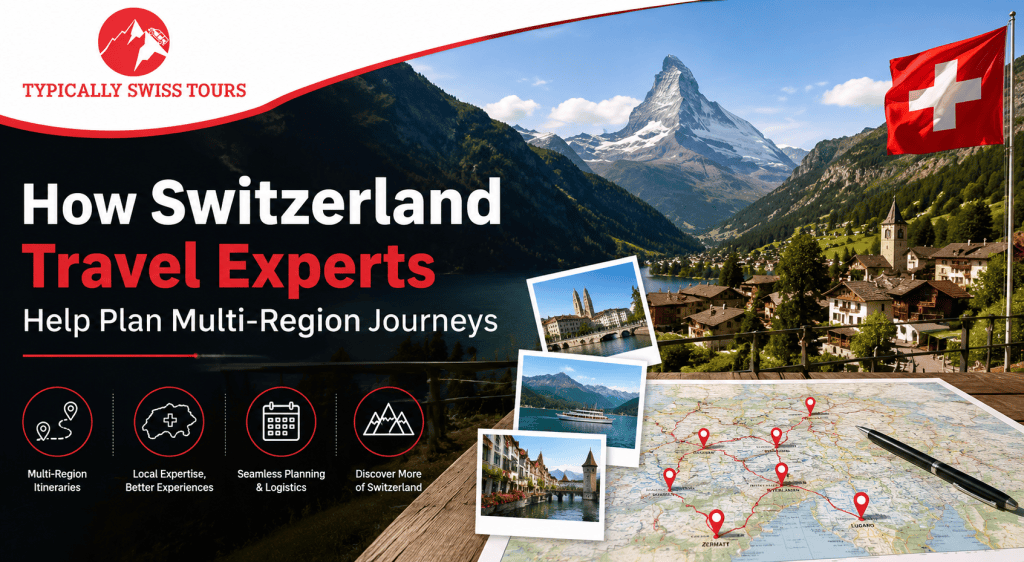
Planning a trip across several regions of Switzerland involves more than choosing beautiful destinations. Travelers need to connect cities, lakes, Alpine landscapes, mountain villages, and cultural experiences in a way that makes sense for their available time. Switzerland Travel Experts help turn a list of destinations into a practical journey by coordinating regional routes, transportation, overnight stays, sightseeing, and local experiences.
For travelers visiting from the United States, thoughtful planning can be particularly valuable when vacation time is limited. Instead of spending too much time moving between locations, a well-designed itinerary balances travel with opportunities to explore each place. Local knowledge also helps travelers understand which destinations complement one another, which activities depend on seasonal conditions, and where flexibility can improve the experience.
Whether you are planning a family vacation, a romantic escape, or a personalized Alpine adventure, understanding how multi-region planning works can help you make better decisions before booking your trip.
What Is a Multi-Region Journey in Switzerland?
A multi-region journey combines destinations from different parts of Switzerland into one connected vacation. Rather than spending the entire trip in a single city or resort, travelers experience several landscapes, communities, and cultural settings.
For example, an itinerary could begin in Zurich, continue to Lucerne and the surrounding lakes, explore the Bernese Oberland, and finish around Zermatt or the Lake Geneva region. Another journey might focus on eastern Switzerland, the Engadin Valley, and Ticino in the south.
Each route offers a different experience. The challenge is deciding how to combine these places without creating unnecessary transfers or rushing through destinations.
Why does regional planning matter?
Switzerland may appear compact on a map, but geographical distance alone does not determine how easy a journey will be. Mountain terrain, transport connections, changes between trains and local services, seasonal activities, and hotel locations all affect the practical route.
A short distance between two destinations can still involve several stages of transportation. Similarly, a scenic journey may take longer than the direct route but offer an experience that travelers specifically want.
Planning should therefore consider three questions:
- Which destinations are most important to the traveler?
- What is the most practical order in which to visit them?
- How much time should be reserved for the journey itself, rather than only the activities at each destination?
Switzerland Travel Experts use these considerations to develop an itinerary in which each region contributes something meaningful to the overall vacation.
How Switzerland Travel Experts Connect Different Regions
The main advantage of expert planning is the ability to coordinate individual travel decisions into one consistent route. A destination may be appealing on its own, but its position within the larger itinerary matters just as much.
1. Creating a logical route
The order of destinations can determine how much time travelers spend exploring rather than transferring between locations.
Suppose a visitor wants to experience Lucerne, the Bernese Oberland, Zermatt, and the Lake Geneva area. Planning these stops requires considering available connections, preferred activities, overnight stays, and the final departure arrangements.
A poorly arranged itinerary may involve avoidable backtracking or leave too little time for mountain excursions. A carefully organized route can make the journey feel more natural, with each destination leading logically to the next.
This does not mean every itinerary must follow the same pattern. Travelers may have specific hotel bookings, family commitments, or activities that influence the order. The purpose of expert planning is to make those requirements work together as effectively as possible.
2. Matching destinations with travel interests
Not every region belongs in every itinerary. The most useful destination choices reflect what travelers actually want to experience.
Someone interested in dramatic Alpine scenery may want to spend more time in the Bernese Oberland or around Zermatt. Travelers drawn to lakeside settings and historic towns may prefer a different balance of Lucerne, Bern, or the Lake Geneva region.
Food enthusiasts might want time for regional specialties, cheese-making traditions, chocolate experiences, or local markets. Travelers interested in cities and culture may want more time for museums, historic centers, and architecture.
An experienced planner helps identify these priorities before suggesting additional destinations. This prevents a common planning mistake: adding famous places simply because they are well known, even when they do not fit the traveler’s interests or available time.
3. Balancing travel time with sightseeing
A multi-region trip should not treat transportation as a minor detail between attractions.
Every change of location can involve packing, checking out, reaching a station or meeting point, traveling, handling luggage, checking in again, and becoming familiar with a new destination. Those tasks can reduce the time available for sightseeing.
Switzerland travel experts account for these practical details when recommending overnight stays and daily schedules. They can help determine when a day trip makes sense, when a new accommodation base is worthwhile, and when staying an additional night could create a more enjoyable experience.
The goal is not to minimize every transfer at any cost. A scenic journey may be one of the highlights of the vacation. The goal is to make sure the journey contributes to the experience instead of creating unnecessary pressure.
Understanding Switzerland’s Main Travel Regions
Knowing what each region offers makes it easier to build an itinerary with variety. The following areas can provide useful starting points for multi-region planning.
Central Switzerland: Lakes, Historic Towns, and Mountain Excursions
Lucerne is a natural option for travelers interested in a combination of historic surroundings, Lake Lucerne, and nearby mountain destinations.
The region can support several different experiences without requiring travelers to change accommodation every day. Depending on the itinerary and seasonal conditions, visitors may explore the city’s old town, take a lake excursion, or plan a mountain outing.
For a longer journey, Central Switzerland can also form a starting point for travel toward the Bernese Oberland or other regions.
The Bernese Oberland: Alpine Landscapes and Mountain Villages
The Bernese Oberland appeals to travelers seeking dramatic mountain scenery, traditional villages, and outdoor experiences. Interlaken, Grindelwald, and the Lauterbrunnen area can serve different purposes within an itinerary.
A well-planned visit should allow time for the experience that matters most to the traveler. Someone interested in walking through mountain villages will need a different schedule from someone prioritizing mountain railways, viewpoints, or more demanding outdoor activities.
Experts can also help determine whether nearby destinations should be explored from one base or incorporated into a longer route.
Valais: Mountain Experiences and Zermatt
Valais is known for its Alpine scenery, with Zermatt being a major attraction for travelers who want to experience the Matterhorn region.
Including Zermatt in a multi-region itinerary requires attention to transportation arrangements and the time needed to explore the area. The best schedule depends on whether the priority is mountain viewing, village exploration, hiking, or other seasonal activities.
Travelers should avoid assuming that arrival and departure days can also accommodate a full day of sightseeing. Building realistic time into the schedule gives the destination room to be enjoyed.
The Lake Geneva Region: Cities, Lakeside Scenery, and Culture
The Lake Geneva region offers a different atmosphere from the high Alpine areas. Depending on the route, travelers may be interested in Geneva, Lausanne, Montreux, lakeside walks, cultural attractions, and local food.
This region can be a rewarding addition to a journey that already includes mountains and smaller Swiss towns. However, it should be included because it suits the overall trip, not simply because it appears on a list of popular places.
Its position may also influence whether it works better toward the beginning or end of a vacation.
Ticino and Eastern Switzerland: Regional Variety
Travelers with more time may consider Ticino, including Lugano, or parts of eastern Switzerland and the Engadin region.
Ticino brings a distinct Italian-speaking cultural setting, while the Engadin offers a different Alpine environment. These destinations can add variety, but their inclusion should be assessed alongside transfer times, seasonal interests, and the total length of the trip.
For visitors with limited vacation days, selecting fewer complementary regions may produce a more rewarding experience than attempting to cross the entire country.
Choosing the Right Transportation for a Multi-Region Trip
Transportation decisions should be made alongside the route, rather than after the destinations have already been fixed.
When trains make sense
Switzerland’s rail network connects many major towns and cities, and train journeys can be an enjoyable part of the vacation. For travelers who appreciate scenery and prefer not to drive, rail travel may be suitable for much of the itinerary.
However, the details still matter. Travelers should check the actual connections, departure times, transfer requirements, luggage arrangements, and proximity of stations to their accommodation.
Mountain excursions may also involve additional railway services, cable cars, buses, or other local transportation. These should be considered when calculating how much time an activity requires.
When private transportation may be useful
Private transportation can be helpful when travelers value door-to-door convenience, personalized stops, or the flexibility to adjust parts of the route.
A private driver-guide may also simplify journeys for families, travelers carrying substantial luggage, or groups with a mixture of interests. The practical benefits depend on the specific service, route, and transportation arrangements offered.
A private tour does not automatically include every train ticket, mountain railway, admission fee, meal, or hotel. Travelers should confirm what is included before booking.
Can you combine trains and private tours?
Yes. A multi-region itinerary does not necessarily need to rely on one transportation method throughout the trip.
For example, travelers might use trains between major destinations and arrange private guided experiences for particular sightseeing days. Alternatively, they may prefer private transportation for a customized route with several stops.
The best arrangement depends on where travelers want to go, how they prefer to travel, and which parts of the journey would benefit most from personal guidance.
How Local Knowledge Makes Regional Travel More Meaningful
Route planning is only one part of a successful multi-region journey. Local knowledge can also help travelers understand the character of each destination and choose experiences that fit naturally into the day.
Switzerland has several national languages, including German, French, Italian, and Romansh, with different languages predominant in different areas. Local customs, cuisine, architecture, and regional traditions can also vary.
Travelers moving from Central Switzerland toward French-speaking areas around Lake Geneva, for example, may notice changes in the cultural atmosphere as well as the scenery. Exploring Ticino introduces another regional perspective through its Italian-speaking environment.
A knowledgeable guide can add context that a basic sightseeing schedule may miss. They may also help travelers decide whether a place deserves several hours or whether it is better approached as a shorter stop along the route.
For travelers considering personal guidance and regional planning support, Typically Swiss Tours: private guided tours of Switzerland provides a useful starting point for reviewing the company’s local tour offering. It is sensible to discuss your preferred destinations, the pace you have in mind, and the type of guidance you expect before deciding on an itinerary.
This kind of conversation can clarify whether a private guided experience fits the journey you are planning.
How a Multi-Region Itinerary Can Be Customized
Two travelers can visit the same Swiss regions and still need very different itineraries. A route should reflect how each person wants to experience the country, rather than follow a template simply because it is popular.
For first-time visitors
First-time visitors may want a balanced introduction to Switzerland, combining a city, a lake destination, and an Alpine region.
Instead of trying to see every famous attraction, they can choose a small number of places that provide variety. This approach leaves time to become familiar with local transportation, explore historic centers, and enjoy the scenery without feeling constantly rushed.
For families
Families may need practical schedules, manageable transfers, and activities that suit different ages.
The plan should account for meal breaks, rest periods, luggage, and the possibility that not everyone will want to follow the same pace. Fewer accommodation changes can make the experience easier, especially when traveling with children or across several generations.
For couples and honeymooners
Couples may prefer a journey with fewer stops, scenic accommodation locations, and more time for private experiences, relaxed meals, or mountain and lakeside scenery.
A customized route can also help make room for a special activity without forcing the rest of the day into an unrealistic schedule. Travelers interested in this style can explore the company’s approach to tailor-made Switzerland tours.
For luxury travelers
Luxury is not only about selecting premium experiences. It can also mean reducing logistical stress, arranging convenient transfers, choosing suitable accommodation locations, and having enough time to enjoy each destination.
Travelers considering luxury Switzerland tours should establish which services matter most to them. Privacy, transportation, guided excursions, accommodation, and special activities may all require separate planning or confirmation.
For travelers with specific interests
Photography, food, history, outdoor activities, and scenic rail travel can all influence the ideal route.
Someone planning around mountain scenery may want additional time in Alpine regions. A traveler interested in regional food traditions may prefer fewer transfers and more opportunities to explore local communities.
Switzerland custom tours can help organize these preferences into a coherent journey, provided the requested activities and arrangements are confirmed with the tour provider.
What a Realistic Multi-Region Itinerary Might Look Like
There is no single route that suits every traveler, but a few illustrative approaches show how regional planning works.
A shorter trip with two main areas
For a shorter vacation, travelers might combine Lucerne with the Bernese Oberland. The first part could focus on the historic city and lake surroundings, while the second provides more time for Alpine landscapes and mountain excursions.
This approach creates variety without requiring a long list of overnight stops.
A week with several complementary experiences
A week-long itinerary might combine a city or lakeside stay, an Alpine region, and a carefully selected additional destination. The order should depend on arrival and departure arrangements, preferred activities, and the time needed to travel between overnight stays.
The important decision is which experiences deserve the most time. Adding another region may not be worthwhile if doing so leaves too little time to enjoy the places already included.
A longer journey across several regions
A longer vacation could connect Central Switzerland, the Bernese Oberland, Zermatt, and the Lake Geneva region, subject to the traveler’s dates and priorities.
Travelers may choose to include additional areas such as Ticino or eastern Switzerland when they have enough time to explore them properly.
These examples are planning concepts, not fixed itineraries. Actual routes should be checked against travel dates, transportation connections, accommodation availability, operating schedules, and the traveler’s preferred pace.
If you are evaluating a private guided trip, the Best Private Tour Company in Switzerland page offers further information about the service approach and personalized travel experiences provided by Typically Swiss Tours.
Seasonal Planning and Backup Options
Weather and seasonal operating schedules can influence multi-region travel, especially when mountain excursions and outdoor activities are important parts of the trip.
A mountain visit planned for a particular day may be affected by visibility, weather conditions, or the operating schedule of the relevant transport service. Some outdoor experiences are also seasonal, so travelers should verify what is available on their intended dates.
Switzerland travel experts can help identify which activities need advance planning and where alternative options might fit. For example, a day built around a mountain viewpoint might have a different backup plan from one focused on a historic town or a food experience.
Flexibility does not mean leaving the entire vacation unplanned. It means identifying the activities that matter most, confirming the details that can be confirmed in advance, and allowing alternatives where conditions are less predictable.
Before finalizing the itinerary, travelers should check:
- The operating dates and times of important excursions.
- The connections required to reach each destination.
- Whether reservations or advance tickets are recommended.
- Which activities could be moved to another day.
- What alternatives are available if an outdoor experience is not practical.
These checks help protect the overall flow of the trip without assuming that every part of the schedule will go exactly as planned.
How to Choose a Switzerland Travel Company for Regional Planning
A suitable travel partner should understand more than individual attractions. The company should be able to explain how the proposed destinations connect and why the route fits your travel plans.
Before booking, ask about its regional knowledge, itinerary flexibility, transportation arrangements, guiding services, and the level of customization available.
You should also request clear information about inclusions and exclusions. Find out whether the quoted arrangement covers private transportation, guide services, attraction tickets, mountain transport, accommodation, meals, or other expenses. These details vary by service, so it is important not to assume that everything is included.
Discuss your travel dates, preferred pace, accommodation preferences, and must-see experiences. Share any practical requirements that may affect the route, including mobility considerations or the needs of children in your group.
A useful proposal should explain the journey clearly enough for you to understand the sequence of destinations, the main activities, and the expected transportation arrangements before committing.
Ultimately, the aim is to choose a company whose approach matches your priorities. You may not need private assistance for every part of the vacation, but professional planning can be valuable when multiple regions and complicated logistics make independent coordination difficult.
Conclusion: Build a Journey That Connects Switzerland’s Best Experiences
The success of a multi-region Swiss vacation depends on how well the individual destinations work together. Scenic landscapes, historic towns, mountain excursions, lakeside experiences, and regional culture become easier to enjoy when the route, transportation, accommodation, and daily schedule are planned as parts of one journey.
Switzerland Travel Experts can help travelers make these connections, identify practical routes, account for seasonal considerations, and shape an itinerary around personal interests. For visitors from the United States, this can be especially useful when making the most of a limited number of vacation days.
The best itinerary is not necessarily the one that includes the most destinations. It is the one that allows you to experience your chosen regions comfortably, with enough time to appreciate what makes each place different.
To discuss a personalized Swiss journey, visit Typically Swiss Tours and explore the available private guided and multi-day tour options.
Frequently Asked Questions
1. How do Switzerland Travel Experts help plan multi-region trips?
They help organize destinations into a logical route, coordinate transportation, assess realistic travel times, and consider accommodation locations, regional experiences, and seasonal conditions. Their guidance can help travelers reduce unnecessary transfers and make more time for sightseeing.
2. How many Swiss regions can I visit in one trip?
The number depends on the length of your vacation, your preferred pace, and the destinations you want to include. A shorter trip usually benefits from focusing on one or two main areas, while a longer vacation can accommodate more regions without requiring such a rushed schedule.
3. Is private transportation necessary for a multi-region Switzerland itinerary?
No. Many travelers can explore Switzerland using trains and local transportation. Private transportation may be useful for door-to-door convenience, personalized stops, or specific routes. The best option depends on your destinations, interests, budget, and travel preferences.
4. Can I combine trains with private guided tours in Switzerland?
Yes. Different transportation methods can be combined within one itinerary. Travelers might use trains for connections between destinations and private guided tours for selected sightseeing days. Confirm the available arrangements, included services, and timing with the relevant provider.
5. Which Swiss regions work well together for first-time visitors?
Lucerne and the Bernese Oberland can provide a useful combination of lake scenery, historic surroundings, and Alpine landscapes. Travelers with more time may consider adding Zermatt or the Lake Geneva region. The most suitable combination depends on trip duration, departure arrangements, and personal interests.
6. When should I book a multi-region Switzerland tour?
It is sensible to begin planning once your travel dates, approximate trip length, and priorities are clear. Booking ahead can provide more time to coordinate accommodation, popular activities, and transportation. Specific timing depends on the season, the destinations involved, and the services you require.
7. Can Switzerland travel experts customize family or honeymoon itineraries?
Many private tour providers offer customization, but the precise options depend on the company and service. Families may prioritize convenient transfers and manageable schedules, while couples may prefer more privacy and a relaxed pace. Confirm the available arrangements before booking.
8. How can I avoid spending too much time traveling between Swiss destinations?
Group destinations that work well together geographically, limit unnecessary hotel changes, and account for actual transportation and transfer time when building the daily schedule. It also helps to prioritize a few meaningful experiences instead of trying to include every famous attraction.
9. What should I ask a Switzerland tour operator before booking?
Ask how the itinerary is organized, which transportation and guiding services are included, whether the route can be customized, and how weather-related changes are handled. You should also request clear pricing and written details of the proposed itinerary so you understand the arrangements before confirming your trip.